
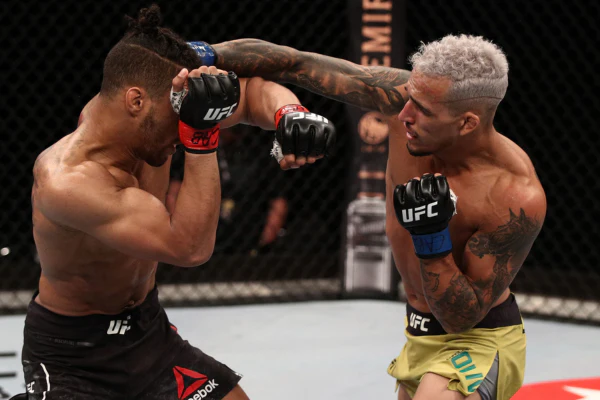
Ever watch a fight where one person seems to be winning easily, only for an announcer to say they’re “losing on the scorecards”? Understanding MMA’s most incredible comebacks starts with that puzzle. The answer lies in the 10-Point Must System, where each round is scored like a mini-game. The winner of the round gets 10 points, the loser gets 9. This means a fighter can absorb huge damage in one round but still be winning the fight on paper, creating the perfect setup for a dramatic turn of events.
Of course, scorecards don’t capture the physical reality of a fight. That’s why our statistical analysis also focuses on “significant strikes.” Think of these as the power shots—the punches, kicks, and elbows thrown with the clear intention of doing damage. This metric separates fight-altering blows from the lighter, tactical shots used just to test distance. It helps us measure exactly how much trouble a fighter was really in before they mounted their rally.
To build this definitive ranking, our model combines these factors to calculate a single “Win Probability” before the comeback happened. This score is based on three key ingredients:
- Official Scorecards (Who the judges thought was winning)
- Damage & Control (Who was physically dominating via strikes)
- The Clock (How much time was left to turn it around)
The result is a simple percentage—a fighter’s statistical chance of winning from that exact moment. The most legendary comebacks are the ones that started with the lowest probability of success.
The Spark of Hope: Fights #25-16 That Defied the Momentum
In mixed martial arts, momentum is a tidal wave you can see and feel. One fighter pours on the pressure, landing shot after shot, while the other covers up, looking for a moment—any moment—to breathe. We can even measure this wave with data: a fighter who is being out-landed by a 5-to-1 ratio in significant strikes has an overwhelmingly low probability of winning. The numbers, the commentators, and your own eyes all tell you the same thing: this fight is over. But the fights ranked #25 through #16 on our list are famous for one reason: they prove that the wave can break in a single, stunning instant.
This is the essence of the “puncher’s chance.” It’s the sport’s most thrilling variable—the idea that no matter how badly you are losing on paper, you are always one clean shot away from victory. It’s the ultimate equalizer. While the other fighter is busy winning minutes and racking up points, the one with the puncher’s chance is looking for a single moment to win the fight. These turnarounds aren’t just improbable; they are statistical miracles that remind us why a fight is never truly over until the end.
A classic example of this is the legendary clash between Cheick Kongo and Pat Barry. After being knocked down twice and nearly finished, Kongo landed a single devastating punch to win. His victory showcased the ultimate “puncher’s chance” in action, proving that as long as a fighter is still standing, they have a path to victory.
The fighters in this part of our countdown all share that same incredible story. They survived an onslaught, weathered a storm that would have finished almost anyone else, and found their one shot to erase a massive statistical deficit. But what happens when that one perfect punch never lands? Sometimes, a comeback isn’t a flash of lightning but a slow, grinding battle to steal victory from the judges’ hands. That’s where we’re headed next.
Stealing Victory from the Jaws of Decision: Fights #15-6
While a stunning, one-punch knockout can erase a bad night in an instant, some of the most dramatic comebacks are born from a slower, more desperate kind of pressure. This is the terror of the clock and the scorecards. As you now know, a fight is scored round-by-round using the 10-Point Must System. Because of this, a fighter can enter the final round knowing, with mathematical certainty, that they are too far behind to win a decision. Their only path to victory is a finish.
This creates one of the most suspenseful situations in sports: the “do or die” final round. Imagine a fighter’s corner telling them, “You’ve lost three of the first four rounds. You need to knock him out or submit him to win.” Even if they go out and completely dominate that final five minutes, winning the round 10-9, the final tally would still be a loss on the judges’ scorecards. The opponent who was ahead simply needs to survive, to run out the clock, while our hero has to sell out completely for the finish.
The pressure of this ticking clock fundamentally changes how a fighter behaves. Calculated defense is often thrown out the window in favor of wild, risky attacks. They might abandon a safe game plan that was losing them the minutes in a desperate gamble to win the fight in a single moment. You can see this shift in their body language and strategy—they start chasing their opponent, throwing every strike with fight-ending power, because anything less than a finish is the same as a loss.
A perfect picture of this desperation is Miesha Tate’s incredible title-winning performance against Holly Holm. For over four rounds, Holm used brilliant footwork and striking to build a commanding lead on the scorecards. Entering the final round, Tate knew she needed a miracle. With just over 90 seconds left in the fight, she got Holm to the ground, took her back, and locked in a rear-naked choke—a powerful submission where a fighter uses their arms to squeeze the neck and cut off blood flow to the brain, forcing a rapid tap-out or unconsciousness. Holm refused to tap and was choked unconscious, giving Tate the last-gasp victory.
The fighters ranked #15 through #6 on our list all share this narrative. They were out-maneuvered, out-pointed, and staring down the barrel of a clear-cut loss. Yet, they found a way to force a finish when it was their only option left. But what about the fights where a comeback requires more than just beating the clock? Next, we’ll look at the fighters who weren’t just losing on paper—they were surviving moments that would have ended almost any other contest.
Surviving the Unsurvivable: Fights #5-3
Losing on the scorecards is a slow, creeping dread. But the fighters in this next group faced a far more immediate kind of doom: a full-blown, fight-ending onslaught. We’ve all seen it. One fighter gets hurt badly, they stumble against the fence, and their opponent swarms them, unloading a barrage of punches and kicks. The referee takes a closer look, ready to step in at any moment. This is the razor’s edge of a TKO loss, where survival is measured in seconds.
For a fighter on the receiving end of this storm, the comeback begins not with a clever move, but with sheer toughness. It’s what fans and commentators often call having a good “chin”—the ability to absorb devastating shots and remain conscious. Surviving this initial blitz is the first, most improbable step. It defies the visual evidence that the fight should already be over. The fighter must weather a hurricane of offense that would have left most others unconscious on the canvas, all while the referee is inches away from waving it off.
But there’s a hidden cost to launching that kind of all-out attack. Imagine sprinting as hard as you can for thirty seconds straight. At the end, your lungs are burning, and your legs feel like lead. A fighter who unloads their entire arsenal trying to get a finish experiences the same thing. They empty their energy reserves, and if their opponent is somehow still standing, the momentum of the fight can shift in a heartbeat. The hunter suddenly becomes exhausted, and the survivor now has a chance to reset against a depleted opponent.
Perhaps no fight in history illustrates this better than Cheick Kongo vs. Pat Barry. Early in the first round, Barry dropped Kongo twice with massive punches. Kongo was so wobbly he could barely stand, and the fight looked seconds from being stopped by the referee. As Barry moved in for the final flurry, he exhausted himself throwing power shots. In a stunning reversal, a still-dazed Kongo landed a desperate combination that knocked Barry out cold. He went from being on the verge of a Technical Knockout (TKO) loss to the winner in an instant, simply by surviving the unsurvivable.
These moments of survival, where a fighter walks through fire and comes out the other side, are the bedrock of the most legendary comebacks. The fighters ranked #5 through #3 on our list are defined by this incredible durability. They took the absolute worst their opponent had to offer, weathered the storm, and found a way to win. And yet, two fights stand above even these, featuring comebacks so statistically unlikely they feel less like sport and more like a glitch in reality.
The Miracles at the Top: The Two Most Statistically Impossible Comebacks
We’ve reached the summit. The previous comebacks were built on toughness and survival, but the final two on our list are different. They represent moments so improbable they verge on the supernatural. To understand just how unlikely they are, our model places both fighters’ chances of winning at less than 1% entering the final moments. This is the statistical equivalent of being dealt a royal flush in poker—a hand so rare you might never see it in a lifetime of playing. It’s a level of improbability where strategy breaks down and history is made.
Entering our list at #2 is the story of a perfect fight undone by a perfect strike. For 24 minutes of their championship bout, Leon Edwards had no answer for Kamaru Usman. The champion, Usman, was stronger, controlling the fight with his wrestling and landing the more effective shots. He was cruising to a clear decision victory, up three rounds to one on every judge’s scorecard. With less than a minute left in the entire fight, Edwards’ corner passionately implored him to “stop feeling sorry for himself” and find a miracle. His win probability at that moment was a minuscule 1.2%.
Then, it happened. Out of nowhere, Edwards threw a high kick that seemed to materialize from a different dimension. It landed perfectly flush on Usman’s head, knocking the dominant champion out cold instantly. The image of the kick is now iconic: a single, flawless technique that completely erased 24 minutes of being dominated. It wasn’t just a lucky punch; it was a calculated, last-ditch effort that had to be executed with zero margin for error. The comeback was so sudden and absolute that the entire arena fell into a state of stunned silence before erupting.
And then there is the one. The comeback that every fan talks about, the story that has defined the very concept for over a decade. For years, Anderson Silva vs. Chael Sonnen was the emotional benchmark for any come-from-behind victory. Now, we have the data to confirm what we always felt: it is, by the numbers, the single greatest comeback in MMA history. For four and a half rounds—a grueling 23 minutes—the seemingly invincible champion, Anderson Silva, was utterly manhandled by his bitter rival. Sonnen took him down at will and punished him with relentless ground and pound, winning every single second of the fight.
Lying on his back with less than two minutes to go before losing his title, Silva did the only thing he could. He threw his legs up over Sonnen’s shoulders and locked his ankles together. This is a submission hold called a triangle choke, where a fighter uses their legs to form a tight triangle around the opponent’s head and one arm. The pressure cuts off the blood supply to the brain, leaving the trapped fighter with a simple choice: tap out to surrender, or go to sleep. Sonnen, caught completely off guard, frantically tapped.
It’s the comeback that had everything: a dominant champion on the verge of being dethroned, a rival who had backed up all his trash talk, and a finish that came in the 23rd minute of a 25-minute war. Our model gives Silva a win probability of just 0.7% before he threw up that fateful submission. It wasn’t just a great story or a “vibe.” It was a mathematical miracle. These moments feel like lightning in a bottle, but are they entirely random? Looking closer at our full list of 25 fights, three distinct patterns emerge, showing the hidden anatomy behind every impossible comeback.
The Anatomy of a Comeback: 3 Patterns Behind Every Miracle
So are these miraculous wins just random flashes of luck? A fighter gets hurt, closes their eyes, and swings for the fences? Not quite. When you analyze the data from all 25 fights on our list, you discover that these aren’t just chaotic moments. They are the result of specific, recurring patterns. Looking past the highlight reels reveals three distinct blueprints that make the impossible possible, showing that even in a fight’s most desperate moments, there’s a hidden logic at play.
The most common dynamic is a battle between endurance and explosive power—what you could call The Battery vs. The Bomb. Some comebacks are earned by fighters who act like a battery, absorbing an incredible amount of damage while draining their opponent’s energy, only to take over late in the fight. But many of the most dramatic wins come from “the bomb”: a fighter who, despite being completely outclassed, possesses one-shot knockout power. Leon Edwards’ stunning head kick against Kamaru Usman is a perfect example. He was losing the war of attrition but had the single weapon needed to win the fight instantly.
Another key pattern is the Specialist’s Trump Card. MMA is a sport of many skills, but you don’t have to be the best at everything to win. As Anderson Silva proved in our #1 comeback, you just have to be the best at one thing at the exact right moment. For 23 minutes, Chael Sonnen was the better wrestler and boxer. But Silva was the master of submissions, and when the moment came, he played his trump card. Many fighters on this list won by luring their opponent into the one area where they held an unbeatable advantage.
Ultimately, the ingredient that unites every single comeback is unbreakable composure. It’s the mental fortitude that allows a fighter to think clearly while exhausted, in pain, and moments from defeat. This is what allows a fighter to conserve their battery, wait for the perfect moment to detonate their bomb, or strategically play their trump card. It’s the invisible force that turns a victim into a victor. Recognizing these hidden patterns is the key to seeing the deeper story of any fight, transforming how you watch the sport from here on out.
How to Watch Fights Like an Expert (Without Needing a Black Belt)
The next time you settle in to watch a fight, you’ll have a new set of eyes. Where you once saw a brawl, you now see the hidden story told by the numbers. You came to this list thinking comebacks were about heart and grit—and they are. But now you know how to measure that grit, seeing it in the mounting strike differential a fighter must overcome, the judges’ scores they have to erase, and the precious seconds ticking off the clock.
This new lens is your key to a deeper understanding of MMA. You don’t need to be a statistician to use it. When you’re watching the next UFC card, simply listen. When the commentators mention a fighter being “down two rounds” or praise a “significant strike,” you’ll understand the true depth of the drama unfolding. Pay attention to the corner’s instructions between rounds; their tone will tell you just how desperate the numbers have become.
You’ve taken a significant step in your journey from casual viewer to informed fan. You can now move beyond simply watching the action to analyzing the situation. You are no longer just a spectator, but someone who can appreciate the strategic chess match behind the physical war, seeing the miracle in the math long before the final blow lands.