
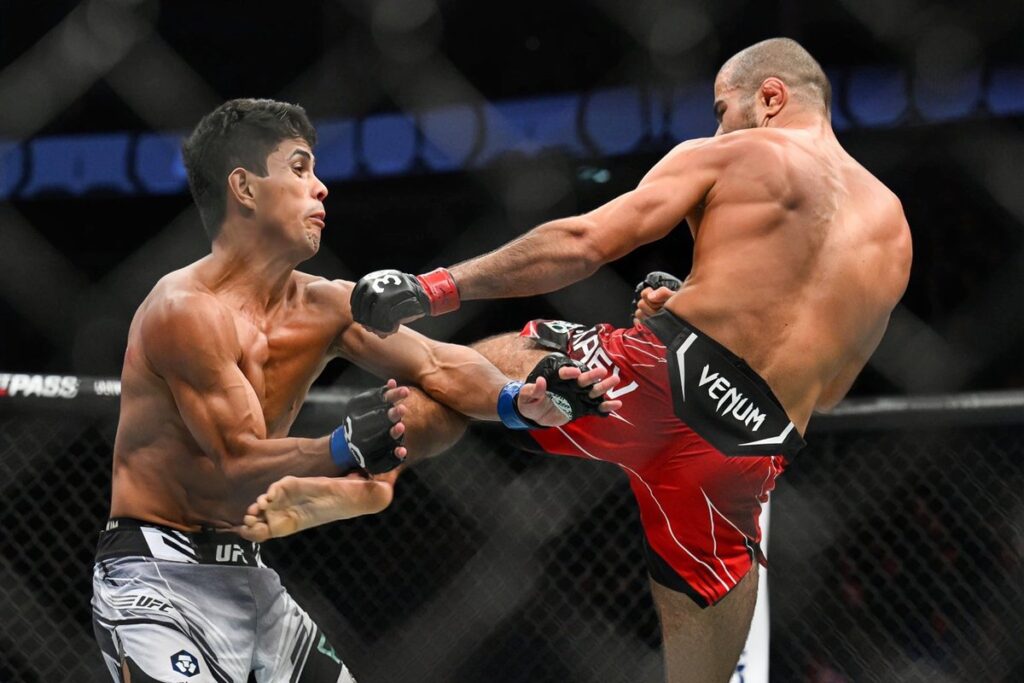
You’re watching the main event. For four straight minutes, one fighter has been pressing their opponent against the cage, controlling them. “Total domination,” you think. But when the bell rings and the official scorecards are revealed, the fighter who was being controlled somehow won the round. How? The answer lies in a simple checklist that judges are trained to follow, and it almost always comes down to one thing.
According to the MMA unified rules on scoring, judges ask one question above all others: “Who landed the more impactful shots?” This focus on damage from effective striking completely outweighs simple ground control. Think of it like this: one basketball team can hold the ball for 20 seconds of the shot clock (control), but if the other team gets a steal and scores a quick 3-pointer (damage), who really won that possession? The incredible weight of damage in MMA judging works the same way.
Only if the damage from strikes and submission attempts is considered completely equal do judges move on to the tie-breakers: who was more effectively aggressive, and who controlled the fighting area. In practice, a round is rarely that even. The debate over effective striking vs. ground control is almost always settled by the immediate impact of the blows, not the time on the clock. This “Damage First” principle is the key to seeing the fight the way the judges do.
Impact vs. a Bloody Nose: How to Spot Fight-Winning Damage
A fighter’s face can be a mask of blood, yet they can still be comfortably winning the fight. This is the crucial difference between superficial damage (like a cut eyebrow or bloody nose that doesn’t impair vision) and impactful damage. Judges are trained to prioritize impact—a strike that stuns, wobbles, or forces an opponent to retreat. A small cut is a paper cut, but a hard body shot that makes a fighter wince is a punch to the gut. One is an inconvenience; the other changes how they fight.
Of all the types of impact, nothing scores more than a knockdown. When a strike forces a fighter to touch the mat with anything other than the soles of their feet, it’s the clearest possible evidence of fight-altering damage. A single, clean knockdown is so significant that it will almost always win the round for the fighter who landed it, and it’s the fastest way to earn a dominant 10-8 score. It’s the MMA equivalent of hitting a home run; it dramatically outweighs almost everything else that happens in the inning.
This is why simply looking at the “significant strike” numbers on screen can be misleading. That stat just counts landed power shots, not how much they actually hurt. Instead of counting punches, start watching the reaction to them. Did a leg kick make the opponent stumble? Did a punch to the jaw make their eyes roll back for a split second? A fighter who lands 15 jabs that are easily absorbed has done less “damage” in a judge’s eyes than one who lands a single, powerful body kick that visibly hurts their opponent.
Ultimately, judges are looking for moments that bring a fighter closer to being finished. Impactful strikes do exactly that. But what happens in a round where neither fighter lands a truly damaging blow and both seem equally matched on their feet? That’s when the debate shifts from damage to control, and when pushing someone against the fence can actually start to matter.
So, When Does Pushing Someone Around Actually Matter?
In those close, grinding rounds where nobody gets rocked, the fight can look like a stalemate. This is where the concept of Fighting Area Control comes into play. Think of it as controlling the “real estate” of the Octagon. Who is the one constantly moving forward, forcing the other fighter to retreat? Who is dictating where the fight takes place—in the center of the cage, or with their opponent pinned against the fence? That person is the one demonstrating control.
However—and this is the part that trips up most viewers—control is a secondary scoring factor. Judges are instructed to score the fight based on effective damage first and foremost. Only if the damage is completely equal do they then look at who was more effectively aggressive. If that’s also a tie, they finally use Fighting Area Control to decide the winner. It’s a tie-breaker for a tie-breaker. A fighter can be backing up the entire round, but if they are landing the harder, cleaner shots while retreating, they are still winning.
This means that a fighter who spends four minutes pressing their opponent against the cage but lands no meaningful strikes is just burning clock. Their “control” looks dominant, but in the judges’ eyes, it’s empty. That opponent who spent just one minute in open space but landed two clean, thudding punches did more to win. This same principle creates another common point of confusion: the takedown. Surely, dragging a fighter to the floor is a powerful form of control, right? Well, it’s not that simple.
The Takedown Trap: Why Dragging a Fighter Down Doesn’t Guarantee a Win
Few moments in MMA are as visually decisive as a powerful takedown. One fighter is standing, and the next they’re on their back, the momentum of the fight seemingly flipped on its head. This is the ‘takedown trap’—the belief that getting the fight to the mat is a huge scoring play. While it is a form of control, judges see it less as a victory in itself and more as a change of scenery.
Think of a takedown as getting a runner to third base in baseball. It’s a threatening position that creates an opportunity, but it hasn’t put any points on the board yet. In MMA, scoring those points means using that top position to land damaging strikes—what commentators call “ground and pound”—or to seriously threaten with a submission like a choke or an armbar. The takedown is the key that unlocks the door to scoring; it is not the score itself.
This distinction is crucial. When a judge sees a takedown, a new question immediately pops into their head: “Okay, what did they do with it?” A fighter who lands a takedown and immediately starts raining down hard elbows and punches is scoring heavily. A fighter who transitions to a position where they can lock in a deep choke that forces a desperate escape is also scoring. They are being effective with their grappling.
Conversely, a fighter who secures a takedown and then simply holds their opponent down for three minutes without inflicting damage has scored very little. Those two solid punches the other fighter landed before being taken down will almost always outweigh the “control” of an inactive top position. This exact scenario creates some of the most heated debates among fans, so let’s put on our judge’s hat and break down a round from a recent, controversial fight.
You Be the Judge: Breaking Down a Controversial Round (Paddy Pimblett vs. Jared Gordon)
Perhaps no recent fight illustrates this clash of styles better than the controversial decision between Paddy Pimblett and Jared Gordon. The bout left thousands of fans scratching their heads and ignited a firestorm of debate online, making it the perfect case study for analyzing controversial fight scorecards. For fifteen minutes, the fight presented a constant, difficult question: what matters more, a few hard shots or long periods of positional control?
For long stretches, especially in the final round, Jared Gordon appeared to be the one in charge. He successfully took Pimblett down and held him on the mat, and he spent significant time pressing Pimblett against the fence. If you were only tracking who was controlling the physical location of the fight, Gordon looked like a clear winner. He accumulated over six minutes of total control time, a number that seems dominant on paper.
On the other side of the coin were Pimblett’s moments of clear, visible impact. While standing, particularly in the first two rounds, Pimblett landed the cleaner and more powerful strikes. These weren’t glancing blows; they were significant shots that snapped Gordon’s head back and visibly affected him. Though these moments were often brief, they represented the most significant damage either fighter inflicted during the bout.
This is precisely where the judge’s official checklist becomes critical. Their first and most important question is not “Who had more control time?” but “Who landed the more impactful strikes and had the more effective grappling attempts?” Control and aggression are secondary factors, considered only if the damage is judged to be completely even. In this fight, the judges decided that the damage from Pimblett’s strikes was not even with Gordon’s, making it the primary factor in their decision.
Ultimately, the official verdict for Pimblett demonstrated the scoring criteria in action. The judges valued the quality of Pimblett’s impactful moments over the quantity of Gordon’s control time. This highlights why judging control-heavy fighting styles can be so difficult and leads to so many arguments. It also raises an important question: what could Gordon have done to make that control time count? The answer lies in the difference between simply holding someone down and true “effective grappling.”
What’s the Difference Between ‘Effective Grappling’ and Just Laying on Someone?
This is the heart of judging control-heavy fighting styles. What transforms minutes of ground control from a dominant performance into a controversial loss? The answer lies in the official term: Effective Grappling. A takedown gets you on the ground, but judges are looking for what you do with it. Are you using that top position to advance your position, land damaging strikes, or hunt for a fight-ending submission? That is effective grappling.
In contrast, there’s a reason fans often criticize a fighter for “lay and pray”—getting a takedown and then simply holding on, praying the clock runs out. This is considered stalling. When a fighter on top is just maintaining control without any real offensive output—no significant strikes, no submission threats—they are not scoring. They are controlling the location of the fight, but they aren’t using that control to win it. This inactivity opens the door for the fighter on the bottom to steal the round.
Believe it or not, a fighter can absolutely win a round from their back. If the person on top is just stalling, but the fighter on the bottom is landing sharp elbows, constantly trying to get up, or threatening submissions of their own, judges are instructed to reward that activity. They are seen as the one being more “effective” in the grappling exchange, even from a supposedly inferior position. It’s a simple rule of thumb: position doesn’t score; impactful action does.
Your 4-Point Cheat Sheet for Watching MMA Like a Pro
Now that you understand the scoring criteria, you can watch a fight like an analyst. The next time you tune in, use this simple checklist to see the action through a judge’s eyes and understand who is really winning.
- Watch the Reaction, Not Just the Strike. Did a punch snap the head back or make a fighter stumble? A visible, negative effect is the clearest sign of scoring damage.
- Listen for the Impact. Sometimes, the sharp thwack of a clean shot or the heavy thud of a body kick tells you more about its power than your eyes can.
- Ask: Is the Control Leading to Damage? A fighter on top or against the cage is only winning if they are using that position to land meaningful offense. If not, it’s just stalling.
- Who is Moving Forward? If damage seems equal, look at who is dictating the pace and forcing their opponent backward. This is effective aggressiveness, the first tie-breaker.
So, when the next controversial round ends and your friend yells, “He was just holding him against the fence!”, you can be the one to calmly point out the damaging strikes that truly won the round. Just remember the judge’s simple priority list: evaluate Damage first, then Aggressiveness, and only then, Control. Welcome to a smarter way to watch MMA.