
What makes Kyle Daukaus’ grappling dangerous for any middleweight?
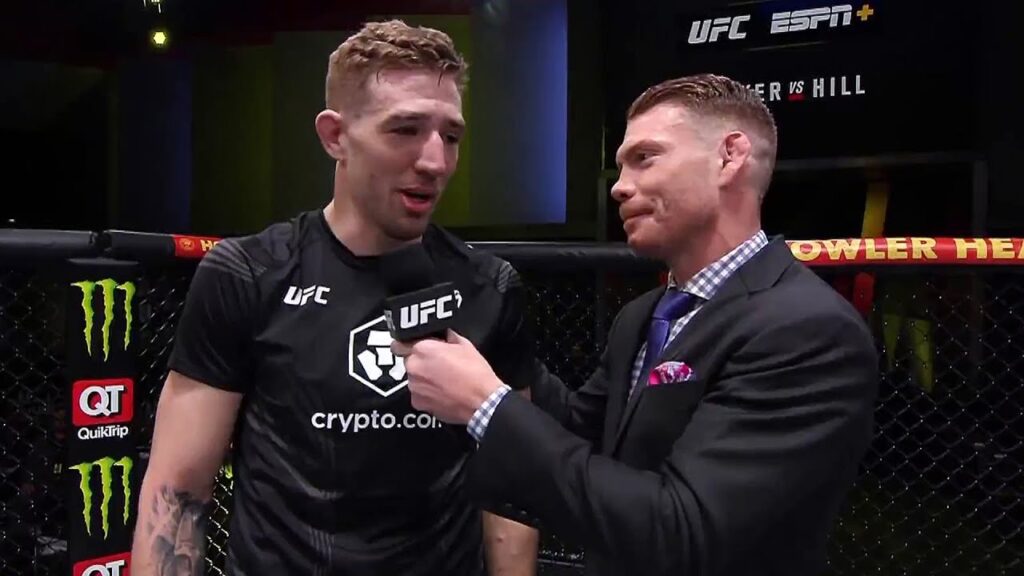
MMA has slowly turned into a sport where nothing is really set in stone and everything is possible. It is important that fighters are well rounded in all three categories—striking, wrestling, and submissions—in order to compete at the professional level. In the course of a fighter’s career, most of them are able to develop a well-rounded skill set, although there are a select few who excel in certain disciplines. For Kyle Daukaus, that specialty is his grappling, which has been a lethal tool in the UFC’s middleweight division. Daukaus is well-known for his slick submissions and positional control and his ability to bring the heat in the ground and pound department. Even though he is not as famous as some of his peers, he is a force to reckon with for any middleweight fighter who may be unfortunate enough to have to face him in the octagon. In this article, we’ll break down the different aspects of Kyle Daukaus’ grappling that make him a dangerous fighter for any middleweight division. We will look at his BJJ experience, his fight record, and how he approaches fights that may cause problems for his division. Furthermore, we will look at some of his previous fights, the significance of groundwork in the middleweight class, and what might be in store for Daukaus as he progresses through his career. The Foundation: Brazilian Jiu Jitsu Black Belt That is where we must look at Kyle Daukaus’ origins in Brazilian Jiu-Jitsu (BJJ) to comprehend why his takedowns are so potent. Daukaus is a BJJ black belt under Jared Weiner, an acclaimed trainer from Philadelphia. His family background is in martial arts; his brother is Chris Daukaus, a heavyweight in the UFC with a reputation for knockouts, but Kyle is a submission grappler. Daukaus’ ability to adapt and push the pace on the ground is an area that he is well-versed in, and this is where many of his opponents may be lacking as well. It is not easy to get a black belt in BJJ; it requires a lot of practice, repetition, and even more training in full-contact sparring with other black belt practitioners. This foundation has paved the way for Daukaus to easily move to MMA, where grappling is usually the deciding factor, especially when two fighters are evenly matched. The term Brazilian jiu-jitsu is centered on grappling with an opponent on the floor and looking for ways to either submit him or keep him down. In MMA, this translates to the ability to shut down an opponent’s striking by taking them to the ground, where a skilled grappler like Daukaus can dictate the tempos of the fight. While some fighters are willing to just lay and pray for points, Daukaus is constantly searching for submissions—something that really separates him as a finisher on the ground. The Grappling Threat: Submissions, Scrambles, and Transitions Submissions: Finisher’s Mentality Another identifying characteristic of Kyle Daukaus’ grappling is his finishers’ approach. He is not satisfied with winning rounds or dominant a fighter; he looks to finish a fight through submission. This makes him a very dangerous fighter because he does not allow his opponent to relax at any one time. In top position or back controlling, Daukaus always looks for submission, which makes him a dangerous fighter. Daukaus has many submission methods at his disposal, though his rear-naked choke and D’Arce choke are unique. These two submissions are very useful in MMA, and Daukaus has applied them to knock out some of his rivals. The rear-naked choke is especially dangerous because it can be applied from various positions, such as the back control, at which Daukaus thrives at maintaining dominant position and positioning the opponent’s neck for the choke. The D’Arce choke, however, is a more complex submission hold that cannot be done from most positions but is applied from a front head lock or during a tussle. Daukaus has demonstrated an ability to capitalize on his opponents when they are at the transitions, and the choke is tightened to show even the most hard-hearted fighters to submit. This willingness and ability to take submission opportunities make Daukaus a fighter who can end the bout at any given time. Scrambles: Winning the Transitions Another part of his game that was discussed in detail is Daukaus’ ability to win scrambles. The most important aspect of the takedowns in the MMA is usually scrambling, although it is usually overlooked in grappling. Scrambles are normally realized when both fighters are on their feet, perhaps after one or both of them tried a takedown or sweep or when a fighter is on the ground and trying to avoid being taken down. These are wild moments, high-intensity ones, but these are when Daukaus shines. The fact that he can manage his scrambles is because of his BJJ background and his feel for grappling. In MMA, scrambles are often the difference between being on top, or in full mount, or being stuck on the bottom. Daukaus’ transitions are fast, and his awareness of the body mechanics gives him an edge in most of such scrambles. He becomes even more dangerous when he gets a position such as side control, mount, or back control. Positional Dominance: Control Over Chaos Although BJJ sweeps and scrambles are hallmarks of Daukaus’ grappling, pressure control is equally as crucial. MMA grappling is not only about submission but also about pinning down your opponent and taking the fight where you want it to go. This is where Daukaus stands out the most. In the style of top control, Daukaus is quite calculated. He does not engage in dangerous stances that can enable his opponent to escape. However, he proceeds slowly from stance to stance, be it from guard, to side control, or mount. When he was once a heavyweight contender, he applied force and forcefulness to ground and pound or attempt submission on his opponents. On the flip side, even when he is on the bottom, Daukaus is never a boring
