
The Rise of Henry Cejudo: Olympic Gold to UFC Double Champion
Henry Cejudo, who came from a poor background to win an Olympic gold and silver medal and also become a UFC double champion, is a man of hard work, strategy, and perseverance. Also called “The Messenger,” Cejudo’s career is full of historical wins that placed him among the greatest athletes in combat sports. This paper aims at analyzing his wrestling career from the time he joined wrestling and the UFC until now, focusing on the achievements, struggles, and effects of his wrestling career. Childhood and the Beginning of Wrestling Challenging Beginnings Henry Cejudo was born on February 9, 1987, in Los Angeles, California, the United States, to Mexican immigrant parents. As for his financial history, he faced many problems and instability in his early childhood. His mother being a single mother who had to work several jobs to feed her six children, Cejudo and his family relocated several times between California, New Mexico, and Arizona. Still, the Cejudo family was a happy one; wrestling became a positive outlet in Henry’s life because of his older brother, Angel. High School Wrestling Success Cejudo started his high school education at Maryvale High School in Phoenix, Arizona, and his ability in wrestling was quickly discovered. He also had four state championships and became a national high school champion. He then gained fame on the mat and was spotted by the United States Olympic Training Center (USOTC) in Colorado Springs to train. This was the start of his journey to the Olympics and more for the young boy. Olympic Dream and Triumph The road to Beijing Cejudo’s participation in the USOTC was an eye-opening experience for him. He trained for wrestling with coaches of national caliber and was preparing himself for the international wrestling arena. Going into the 2008 Beijing Olympics, Cejudo became a member of the U.S. Olympic team at the tender age of 21. He was wrestling in the 55 kg (121 lbs) freestyle wrestling event and was competing against other very experienced and skilled wrestlers. Olympic Gold Medal Achievement Henry Cejudo wrote his name in history on August 19, 2008, by outpointing Tomohiro Matsunaga of Japan to clinch the gold medal. He is one of the young American wrestlers who managed to gain the Olympic gold; in addition, he is the first wrestler to gain the victory in freestyle wrestling since 1996. It was a great accomplishment that he made, not only for himself but for his family and the people in his community as well. That performance proved that he can come back from the losses he had before, thus establishing him as a wrestling champion. Transition to Mixed Martial Arts Entering the MMA World After winning the Olympics, he needed more challenges, so he left wrestling and joined mixed martial arts (MMA). The main internal factors that enticed him to make a decision were the challenge of entering the new sphere of activity and higher monetary incentives. Cejudo started his professional MMA career in March 2013, and because of his wrestling base and athletic ability, he became one of the top fighters very soon. Joining the UFC In 2014, Cejudo joined the UFC’s roster and stepped into the flyweight division, which was full of talented fighters. His first professional bout was in December 2014 against Dustin Kimura, and he did not disappoint, winning via unanimous decision. This triumph may be regarded as the first step in the UFC career of the man and the start of his performance with further victories. UFC Flyweight Champion Climbing the ranks Despite this, Cejudo’s wrestling background was a big plus for him, but he had to incorporate all-round skills in order to compete at this level of MMA. He focused on his stand-up and ground game, working with the best coaching personnel, and fighting with the best fighters. It yielded results as he rose through the flyweight division to beat top fighters like Chris Cariaso and Jussier Formiga. First Title Shot and Setback Cejudo next competed in April 2016, when he matched up with the flyweight division’s long reigning and defending champion, Demetrious “Mighty Mouse” Johnson, at UFC 197. In his fight, Cejudo was knocked out by TKO in the first round despite his endeavors. Such a loss was a good lesson that made him work hard to become a champion. Cejudo had to go back to the drawing board, therefore making a major change to his training and strategies. Redemption and Championship Victory This desire saw Cejudo face Johnson once more at UFC 227 in August 2018. The fight was a nail-biter, and Cejudo won the fight via split decision, which put an end to Johnson’s long-standing reign as the UFC flyweight champion. This win was very important in the career of Cejudo since he proved that he could learn from his losses and become great. UFC Bantamweight Champion Ambition for Double Gold Cejudo, however, was not one to sit on his throne and declared his intention to ascend to even higher realms. He wanted to be a two-division champion, so he set his sights on the bantamweight category. His self-confidence was followed by both criticism and fans’ appreciation in equal measure. Unfazed, Cejudo trained hard for the task at hand. Bantamweight Title Fight Cejudo had another title shot in the UFC bantamweight title when he fought against Marlon Moraes in June 2019 at UFC 238. Still, Cejudo struggled in the first round, but he was able to display great fighting spirit that made him capable of making adjustments that he used to dominate the fight during the later rounds. He knocked out his opponent in the third round and made his record of being one of the few fighters to win championships at two weight classes. Defending the title Cejudo’s first title defense was against Dominick Cruz, the former bantamweight champion, at UFC 249 in May 2020. In another great fight, Cejudo knocked out his opponent in the second round by TKO. After the fight, he declared his retirement from
Henry Cejudo Among 9 Fighters Suspended 180 Days After UFC 298
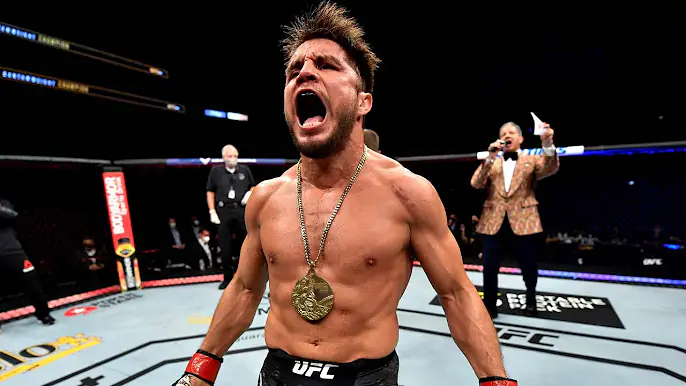
The result of the event on May 28 in Anaheim, California, showed that it was a night of war and bloodbath in which fighters fought wildly and clashed violently. The fight featured a stellar lineup of 12 fights involving 24 fighters who unleashed their counterparts on the canvas, where their muscles went through immense pressure while their bones shattered and their bodies, beyond the limits, straight into an arena! Among the 39 referees and combatants who entered the ring that night, Henry Cejudo was the only one who was banned from the UFC for a whole six months. Since they presumed that the fracture of his left forearm was an incident that happened during his fight, Since he is known for his stubborn courage and focus on the goals, as demonstrated in past UFC victories, his failure could drag him into a long arousal of health and physical cover-up for Cejudo. Cejudo was not the only one who faced the adverse effects of intense competition. In the same manner, Miranda Mover and Andrea Lochiar were also suspended for seven days in this thrilling match as part of the mandatory rest period. Yet short-term bouts of such symptoms are generally negligible in the grand scheme; however, they serve to remind us how a single bout of such symptoms can have highly undesirable effects on the body. Oban Elliott and Val Woodburn, who were utterly subjected to gruelling battles that took out all of their abilities, were both judged with 60 days of penalization, and they could not be exempt from their first 30 days. They did not reveal the exact damages or injuries that they inflicted, but such injuries must not be ignored as they portray the intense physical nature of the sport. However, that does not overshadow the risks that fighters take as they chase their victory. The second largely worrying element of UFC 298 was the high likelihood of fractures among many fighters. Danny Barlow, Mingyang Zhang, Carlos Vera, Marcos Rogerio de Lima, Mackenzie Dern, and Robert Whittaker are among those who have the future in the world of MMA at a high risk of cracking all over their bodies in different parts. Instead of Barlow, who suffered from fracturing his left forearm and was suspended for 180 days, he too was awarded probation for 45 days for pleading guilty to engaging in a ferocious fight. The fate of Zhang is identical to that of Barlow because he also fractured his right hand, as a result of which a 180-day ban was imposed on him at the same time. However, while Vera’s working career will be put on hold temporarily, her shoulder problem is looking to be a severe one that might require over half a year of rest. Both Dern and Whittaker have equally high outcomes and are facing the consequences. This time they could have both serious sports injuries—Dern may have fractured her left leg and Whittaker his hand—which will compromise their immediate sport achievements and long-term health as professional fighters. For UFC 298, fighters such as Josh Quinlan, Brendson Ribeiro, Junior Tafa, and Paulo Costa have been placed on the injured reserve list after being hurt while in action. The possibility that a fight ends up with a TKO or a severe injury has always emphasised the physical and combative nature of MMA. Even though the occurrence of injuries and suspensions was the main problem, athletes like Amanda Lemos, Anthony Hernandez, and Ilia Topuria succeeded in great victories. Although they were not winning, Lemos and Hernandez were suspended owing to the fact that their actions got too intense to harm themselves or their opponents, hence the intensity of their fights. As a consequence of UFC 298, now the fighters battle with different opponents—their own bodies—while recovering from injuries inflicted by a fight of this level. Others may have a more difficult and long journey, while some people only have to deal with a few obstacles. At the end of an epic combat, dust will settle; each fighter’s path to the next fight appears completely different yet equally challenging. Although they encounter difficulties in their ways, it is clear that the resilience of UFC fighters survives through tough times. The indestructible spirit that cannot be defeated typically resonates in the corner of the ring, both through the fighting itself and beyond the octagon.
