
How Alexandre Pantoja’s mental toughness made him a UFC champion.
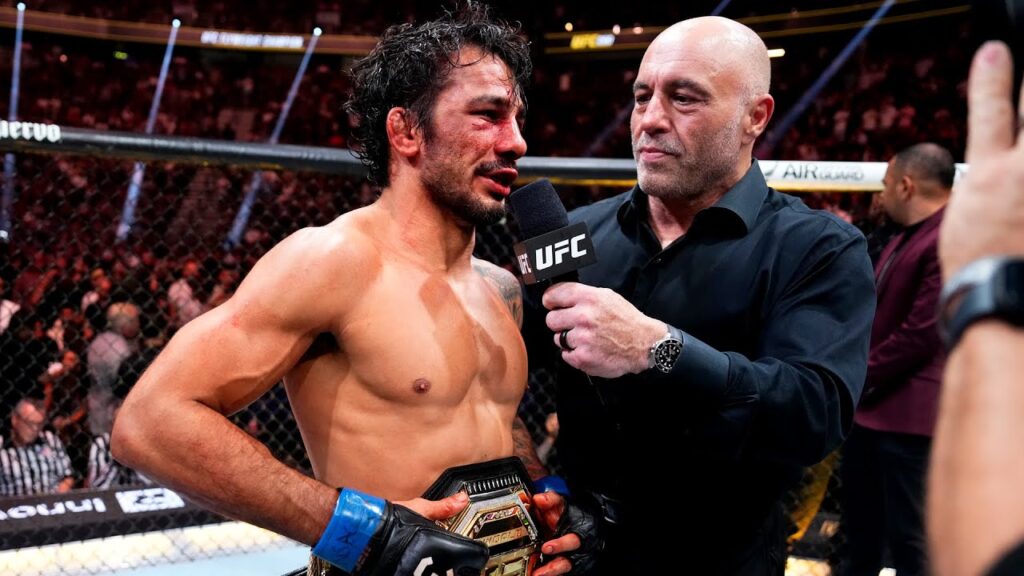
MMA is as much a fight of the mind as it is of the body and this is something that is often overlooked. The Octagon is not only a place where physical strength is put into a trial, but also psychological and emotional strength. Many of the fighters are talented and have the physical abilities that can help them win the fights and become champions but there is something that sets the champions apart from the rest. Alexandre Pantoja is another fighter in this list, a man whose mental strength has been almost as important as his skills. Alexandre Pantoja had always wanted to become the UFC Flyweight Champion and he made it happen in July of 2023 when he won the title against Brandon Moreno via split decision at UFC 290. The battle which has been described by many as one of the best in the history of the flyweight division was a clear indication of Pantoja’s toughness, determination and confidence. But this victory was not achieved in a day; it was the result of many years of struggle, efforts and, above all, a strong will power. In this article, the author will look at how Alexandre Pantoja’s mental strength that was developed during the tough years led him to become the UFC champion. First of all, we will describe the early stages of his career, the difficulties he faced and the turning points in his life. Last of all, we will discuss how Pantoja’s mental strength has become his biggest asset when fighting in the Octagon. Early Years: The concept of Mental Toughness. Mental toughness is not something that one is born with; rather it is developed over the course of a lifetime through work, struggle and self-improvement. For Alexandre Pantoja, his mental toughness was being developed even before he entered the world of UFC. Pantoja was born on April 16, 1990, in Rio de Janeiro, Brazil, and thus raised in a country where MMA is a lifestyle and where legends like Anderson Silva and José Aldo are considered national pride. But, as it often happens with fighters from poor families, Pantoja’s road to the top was not a bed of roses. He was raised in a rather tough environment and that is why he had to learn how to struggle and stand up for himself from an early age. MMA, therefore, was not only an interest, but also a means of self-fulfillment and a source of an opportunity to let off steam in the megacity of Rio de Janeiro. Pantoja started practicing Brazilian Jiu-Jitsu (BJJ) at the age of 15 and this would be the stepping stone to his MMA career. BJJ is very scientific and one has to have a lot of patience in order to practice it. Pantoja has trained in BJJ and the experience he gained in the discipline prepared him for the nature of combat sports where victory is not easily achieved. Pantoja began to train and compete in local tournaments and experience the joy and sorrow of training which eventually shaped his mental strength that is characteristic of his fighting style. He had the passion and the drive to excel in a sport that required one to have a strong body and mind. The Early Struggles: Resilience in the Midst of Challenges Alexandre Pantoja had his initial career in the UFC before switching to the Brazilian Mixed Martial Arts where he fought in the local shows. In the initial years of his career, Pantoja had to struggle through several challenges such as inadequate funding, scarce training facilities, and the challenge of performing against strong competitors. Life of a regional MMA fighter in Brazil is not a bed of roses as people may think. Fighters have to take up other employment opportunities to cover their needs and they have very tight training regimens that do not allow much time for anything else. Pantoja, like so many others, had to fight his way up and through the ladder of the competition. This is the time when his physical and mental strength was put to the test. The only thing that Pantoja could not predict was the reality of whether or not his dream of becoming a world-class fighter would ever come true and this was a burden that he had to bear, but he never gave up on his dreams. It was therefore not surprising to see him get a chance to represent the country in an international arena. In 2014, Pantoja appeared on “The Ultimate Fighter: The above mentioned has shown that inclusion of Latin America as a member of the cast is appropriate. It was however a great experience even though he did not clinch the championship as he wanted. It helped him to perform in front of a larger number of people and attract the attention of UFC representatives. Most importantly, it gave him an opportunity to develop himself mentally as he was exposed to high stakes games against some of the best talents in the world. Still, Pantoja would have to endure before getting his shot at the UFC through the show. He moved on to other organizations and started piling up victories and gaining more experience. The late call to the UFC could have been a demoralizer to most fighters, however, for Pantoja it was just another challenge to conquer. His patience was also his mental strength and it was being rewarded as he continued to sharpen his skills and build towards his first UFC fight. Entering the UFC: The First Big Test of Mental Toughness Pantoja made his entrance to the UFC in 2017, fighting with Eric Shelton, the winner of the reality show The Ultimate Fighter. At this time, Pantoja had already earned a great deal of victories, but the UFC was a higher level of competition, a promotion that contains the highest level of fighters in the world. The pressure of competing in the biggest stage of the sport can bring down even the most
Alexandre Pantoja: The underrated dominance of the UFC flyweight champion
In the fast-paced and action-packed sport of mixed martial arts (MMA) there are few weight categories as exciting, dynamic, and technical as the flyweight division. The flyweight division is characterized by an amazing balance of velocity, accuracy and variety; the fighters do not have the impact of the higher weight categories, but they do not let their opponents sleep, demonstrating a stunning technique. This is one of the most overlooked divisions where Alexandre Pantoja has been able to build his career and be ranked among the best UFC champions. However, irrespective of the achievements that he has made, Pantoja is still not a very popular fighter in the sport, whereas his abilities and spirit put him in the rank of the best fighters. In this article we go through the career of Pantoja starting from when he was a Brazilian Jiu-Jitsu (BJJ) prodigy and ending with him being the UFC Flyweight Champion. I will discuss his technical superiority, why he was never given the credit he deserved through his reign and why Pantoja should be considered amongst the legends of this sport. The Humble Beginnings: The Journey of Pantoja to MMA Alexandre Pantoja was born on 16 April 1990 in Rio de Janeiro, Brazil, and he has been brought up with the knowledge of the art of fighting. Like many Brazilian fighters Pantoja began his journey in the Brazilian Jiu-Jitsu, a martial art that is focused on ground fighting and submissions. BJJ is not only a sport but more of a pride of Brazil and Pantoja’s fast rise to grappling stardom made him an instant hit. As he reached his teenage years he was participating in the high-level competition, and it looked like he was destined to be a combat sportsman. But Pantoja was not content with being just a grappler. He wanted to become a full-contact martial artist that is why he studied striking arts and wrestling which are the components of the modern MMA. With time he expanded his desire and in 2007 at the age of 17, Pantoja started his professional career in MMA. In the following years, he competed in regional shows all around Brazil and gradually built a reputation of a dangerous man with a well-rounded skill set that includes both striking and grappling. However, it was not easy for Pantoja to get into the international arena despite his apparent skills. There are hundreds of thousands of fighters from around the world aspiring to become the next big thing in MMA and it’s not easy to rise above the noise. For Pantoja, his big break was in 2016 when he was picked to be among the participants of The Ultimate Fighter (TUF) Season 24. The show that was based on the flyweight category had the winner get a shot at the then reigning and defending UFC Flyweight Champion Demetrious ‘Mighty Mouse’ Johnson. The Ultimate Fighter Experience and UFC Entry This is considered as one of the milestones of Pantoja’s career since he was able to join The Ultimate Fighter. Making his debut in the TUF house with an eight-fight winning streak, Pantoja was considered one of the frontrunners to clinch the title. His grappling background and versatility were a nightmare for many of the fighters, and he did not take long to show that. Pantoja did not win the tournament; he was knocked out in the semifinals but his performances on the show earned him a contract with the UFC. It became a significant achievement for the Brazilian as it paved the way for him to join the largest organization in the MMA. His first fight for UFC was in January 2017 where he faced Eric Shelton in the UFC Fight Night 103. The fight was declared in favor of Pantoja by split decision and this proved to the world that he was a worthy contender in the group of the best flyweight fighters. From there Pantoja ramped up his UFC flyweight division run, defeating respected veterans, and highly touted talents. His wins over Neil Seery, Brandon Moreno and Matt Schnell demonstrated his ability to adapt and his increasing effectiveness in stand-up exchanges. However, even with the list of accomplishments, Pantoja still could not garner the interest of the MMA fans. The Overlooked Warrior: History of UFC: UFC’s Early Days The Brazilian earned a series of spectacular victories in the early stages of his UFC career, but Pantoja remained relatively unknown. This lack of recognition was not because Pantoja was not skillful or did not give exciting performances— he was both —but a number of circumstances beyond his control. For instance, at the time the UFC flyweight division was characterized by fighters such as Demetrious Johnson and later on Henry Cejudo who received much of the division’s attention. Johnson, particularly, dominated the flyweight division for many years. Often considered as the best fighter in the history of MMA, Mighty Mouse reigned the division for six years and his reign made it hard for other fighters to get the kind of attention they needed. As Pantoja was piling up wins, Johnson’s record-setting title run and Henry Cejudo’s emergence dominated most of the conversation. Also, there was the same idea about the UFC organization which looked like it was unsure about the further development of the flyweight division. It was speculated that the promotion was planning on doing away with the 125-pound weight division which would have left many fighters such as Pantoja out of work. Luckily the division did not disappear but the air of ambiguity added to the neglect of the flyweight classes. Despite these external conditions, Pantoja kept on perfecting his work. In each fight he grew and while his triumphs may not have been greeted by the scream of the mainstream culture they were significant to the astute observer. The Rivalry with Brandon ‘The Hitman’ Moreno One of the major fights that defined Pantoja’s career was in 2018 when he fought the hungry and ambitious Brandon Moreno at UFC Fight Night 129.
Unveiling The Drama: Analysing The Controversial UFC 301 Title Fight
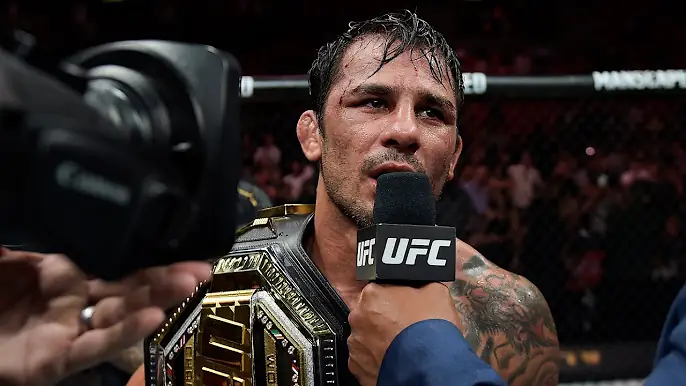
The stage had never seemed so invincible when Aussie contender Steve Erceg engaged with the current flyweight champ. Alexandre Pantoja in an effort to capture the flyweight belt. The sentences were shifting, and judges’ scorecards being presented stirred passionate discussions in the MMA community about whether Erceg stole victory or whether Pantoja deserved to retain his crown. Leading the discussion is the person who used to be the UFC middleweight champion, Robert Whittaker. As you read him, you will understand deeply and clearly what happens in the fight and the terrain of the changing way to score in modern MMA. Having come to the UFC stage much later than Pantoja, it could not be a precarious situation for Erceg as he was facing a professional with more than two years of experience in that sport. Despite the fact that all these things spoiled Erceg’s victory odds, only his show of persistency and strength made Pantoja to the very edge of an octagon for 25 long minutes. This fight was a rough one. Tears and blood were the witnesses to this boxing match, who could name a round when Glass’s opponent left her breath. During these match-ups, there were periods of rising and falling tides as each contesting corner was in and out of a better position, making the fans and commentators no less excited. Nonetheless, as the last note of the anthem played and the judges were forced to make their decision, there was one direct conclusion, and that was controversy. Despite the victory and the final scorecards that read 48-47, 48-47, and 49-46 in favour of Pantoja, many in the audience felt that the outcome proved to be unfair to Erceg as he was searching for the victory that had already been lost to him before the fight. Here is Robert Whittaker, a perpetually experienced and professional participant in the UFC who takes this sport seriously. After one of the most contested title bouts at UFC 301, Whittaker shared his insights on the subject, touching on the complex rules and the details of a world championship match. Whittaker’s research focused on the leadership characters, which showcased the main scenes that very much determined the ending. While accrediting Pantoja for the bravery noted, Whittaker stressed the latter’s superiority in controlling the pace of engagement, thereby resulting in Pantoja’s ability to dictate the terms of engagement and emerge on the winning side over Pantoja. One of the central themes of Whittaker’s commentary was the evolution of MMA scoring. Gone are the days when takedowns and control time alone could secure victory; today’s judges place greater emphasis on effective striking and aggression. Whittaker’s own experiences in the Octagon served as a testament to this shift, as he recounted instances where control time alone was not enough to sway the judges in his favour. Consequently, Whittaker not only provides minute instructions about their criteria but also insists on the need to have experience in competition for those who would like to achieve a championship-level performance. As he set the tone for a dynamic combination of skills and experiences from Erceg and maturity and experience from Pantoja, he made progress in the fullness of both sides. Whittaker recalled and told some important movements of Pantoja in which the trick was followed, like in combat situations. He could act accordingly, and with the knowledge he had, he could have a quick upgrade in the same situation to maintain authority and win. The sparks of the decision of Whittaker to choose Pantoja were matched with his detailed analysis; however, he was also pained by the situation of Erceg. One of the things we share with Whittaker is the groomed disappointment that comes when not everything works out the way we traced career rationality. In search of a new tactic for the protege, Herg bade a youthful student goodbye, but he believed the end of the name Erceg’s road was only a crossroads for him. Ahead, you are a Neophyte who stands about to get into Chimaev’s ring for a fight. Beyond that line, you are a man who fights. By Whittaker’s path, which includes not only the highs and lows of championship fights but also a valuable eye-opening experience, it’s his perspectives that add to every fighter and even people outside of this sport, as they have an opportunity to gain insight into how this sport really looks from day to day. In the few months prior to UFC 301, news outlets announced that the match between Erceg and Pantoja had been booked, triggering a wave of excitement amongst fans. For Erceg, the chance of becoming the UFC champion within only four fights was more than just a dream come true—the idea of having his name mentioned with the rest of the MMA greats. On the other hand, Pantoja was as tough as a task, just like Bogado, who is an unbeaten titleholder in the flyweight division. As they walked the Octagon towards the ring, the crowd was electrified with enthusiasm as both were already putting their hearts into the fight, although they hadn’t started yet. The start of the fight was no longer a familiar feeling, not the usual title fight battle; instead, it was a contest to the finish, the fraying of the skill, the desperate desire, and the steely resolve. The range between the two men escalated slowly, each trying to wrench the game to their advantage, responding and inciting others in order to find the right increment, where the weak spot was revealed. Seconds could pass in nanoseconds, kimura’s and leg locks could appear as if from nowhere, and it’s a combat where fans were pleased to bribe the thermometer of their blood pressure. In the middle of the chase, the commentary team was not able to match the pace of the fight because of its highly intense nature; their voices toughened the roof with each change of momentum. Time and time again, voters were left mulling over the selections they
